Do You Actually Need Enterprise SSO? (Probably Not Yet)
Every auth vendor wants to sell you SSO. But do you actually need it right now? Here's the honest truth about when to add enterprise features to your SaaS.
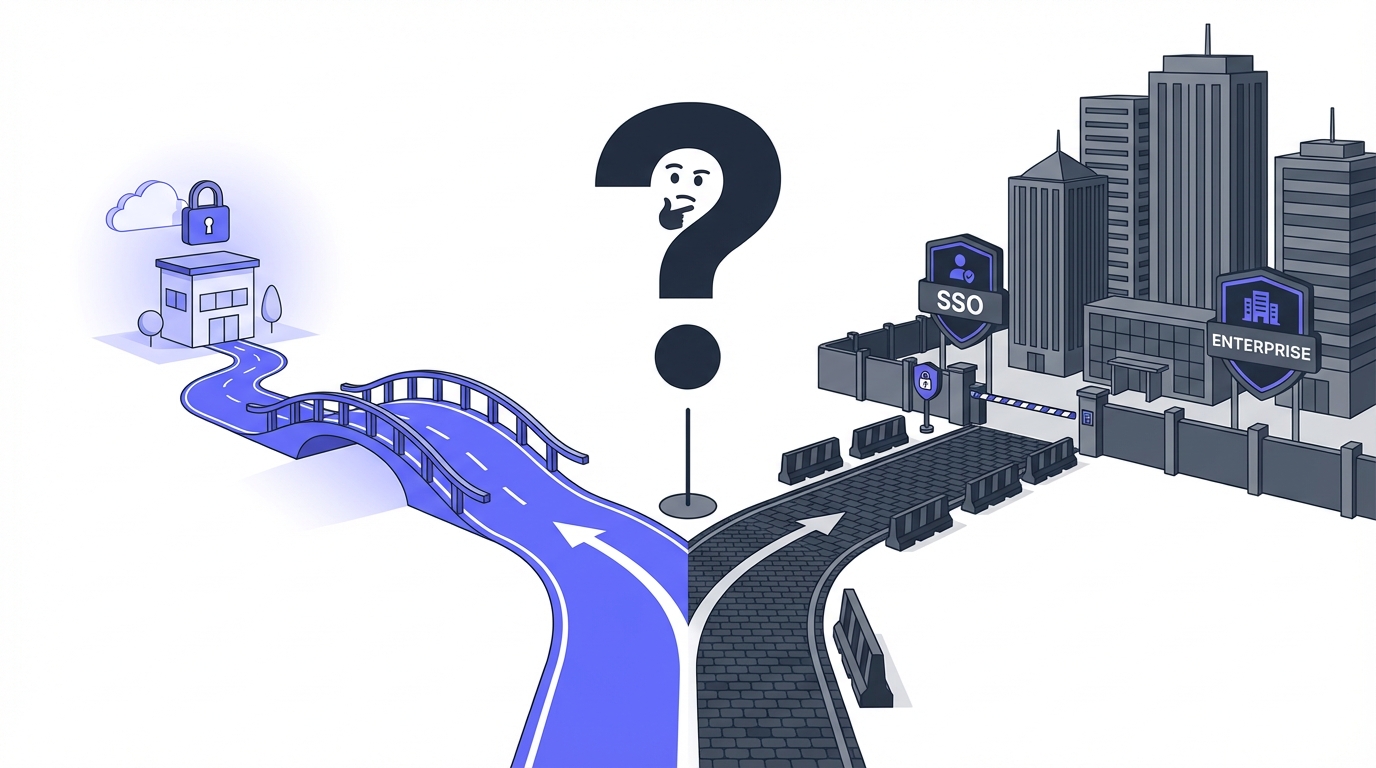
Let me guess: you're building a SaaS product, and every authentication provider you've looked at is pushing enterprise SSO like it's essential from day one. Their pricing pages make it seem like you're missing out on something critical. Their sales teams hint that serious companies need SSO.
Here's what they won't tell you: you probably don't need enterprise SSO yet.
I know, I know. That's a weird thing for an auth company to say. But hear me out. This isn't about saying SSO is bad—it's actually a genuinely useful feature for the right customers at the right time. This is about timing. About building for the users you have today, not the enterprise customers you hope to have someday.
Let's talk about when SSO actually matters, when it doesn't, and how to make this decision without vendor hype clouding your judgment.
What Enterprise SSO Actually Is
Before we talk about whether you need it, let's clear up what SSO actually means. Because "SSO" gets thrown around a lot, and not all of it is enterprise-level complexity.
Social login (signing in with Google, GitHub, etc.) is technically single sign-on, but that's not what we're talking about here. That's table stakes for modern apps, and you should probably offer it regardless of your customer type.
Enterprise SSO is different. It's when a company's IT department provisions access to your application through their corporate identity provider. Instead of users creating individual accounts with passwords, they sign in through their company's centralized system—usually using SAML 2.0 or OIDC (OpenID Connect) protocols.
Here's how it works in practice:
- A company signs up for your product
- Their IT admin connects your app to their identity provider (Okta, Azure AD, OneLogin, Google Workspace, etc.)
- Employees at that company can now access your app using their work credentials
- When an employee leaves, the IT admin removes access in one place, and they're locked out everywhere—including your app
- The company can enforce security policies (MFA, password complexity, session timeout) centrally
For enterprises, this is gold. Centralized control, simplified security, easier onboarding and offboarding, compliance with internal IT policies. It's why they ask for it—and sometimes refuse to buy without it.
But that doesn't mean you need to build it today.
Quick Self-Assessment: Do You Need SSO?
Answer these five questions honestly:
| Question | Your Answer |
|---|---|
| Are you currently selling to companies with IT/security teams? | Yes / No |
| Have 3+ prospects explicitly requested SSO in the last month? | Yes / No |
| Have you lost a deal specifically because you lack SSO? | Yes / No |
| Do you have an enterprise pricing tier over $10K/year? | Yes / No |
| Are most of your customers organizations, not individuals? | Yes / No |
If you answered "No" to most of these, you probably don't need SSO yet. Keep reading to understand why.
If you answered "Yes" to 3+, SSO should be on your roadmap within the next 6 months.
Signs You DON'T Need SSO Yet
Let's start with the reality check. You don't need enterprise SSO if:
Your customers are individuals, not companies
If you're selling to solo developers, freelancers, content creators, or individual professionals, SSO is irrelevant. They don't have a corporate identity provider. They don't need centralized access control. Skip it entirely.
Examples: developer tools for side projects, personal productivity apps, creator platforms, portfolio builders.
No one has actually asked for it
This is the big one. If your sales pipeline is quiet about SSO, if support tickets never mention it, if your enterprise prospects aren't bringing it up—you don't need it yet.
Your users are literally telling you what they need by not asking for SSO. Listen to them.
Founder Trap: Building features you think enterprise customers will want before you have enterprise customers is procrastination, not planning.
You have fewer than 10 team/organization accounts
SSO starts mattering when companies with real IT departments are using your product. If you're counting your team accounts on two hands, you're not there yet.
Most companies under 50 employees don't have dedicated IT/security teams enforcing SSO requirements. They're fine with email/password or social login.
You're still figuring out product-market fit
If you're iterating on core features, experimenting with positioning, or trying to find your ideal customer—adding enterprise features is a distraction. Focus on the product that makes people want to buy in the first place.
SSO is a "nice to have" that helps close deals for a product people already want. It won't create demand where none exists.
Your pricing page doesn't mention "enterprise"
If you don't have an enterprise tier priced at thousands of dollars per year, you're not selling to companies that need SSO. And that's fine! Not every SaaS needs to go upmarket.
If your highest tier is $99/month, your customers aren't the ones demanding SAML integration.
You're pre-revenue or pre-$10K MRR
At this stage, your priority is proving people will pay for your product at all. SSO is an optimization for a sales motion you haven't validated yet.
Get to $10K MRR with basic auth first. Then worry about enterprise features.
Signs You DO Need SSO
Alright, so when does SSO actually matter? When your business is telling you it matters:
Enterprise prospects are explicitly asking for it in sales calls
Not "nice to have" questions—"we can't buy without it" requirements. When you start hearing:
- "Our security team requires SSO"
- "We need SAML for compliance"
- "Can you integrate with Okta?"
- "Do you support Azure AD?"
That's your signal. One prospect asking is interesting. Three prospects asking in the same quarter means it's time.
You're losing deals specifically because of SSO
This is the ultimate validation. If you're getting to the final stages of enterprise deals (security reviews, procurement checklists) and losing them because you can't check the SSO box, it's time to build it.
Calculate the cost: if you lost $50K in deals because you lack SSO, and implementing SSO costs $5K/month in auth provider fees, the math is obvious.
Your customers have IT and security teams evaluating vendors
When you're selling to companies large enough to have dedicated security people, SSO becomes expected. These teams have standardized on identity providers (Okta, Azure AD, OneLogin) and expect vendors to integrate.
If you're filling out security questionnaires and seeing SSO-related questions, take note.
You're ready to charge enterprise pricing
SSO isn't just a feature—it's a revenue opportunity. If you're building an enterprise tier priced at $10,000+ per year, SSO should be part of that package. The companies paying that much expect it.
It also gives you a way to segment customers: self-serve customers use email/password, enterprise customers get SSO. This tier differentiation supports your pricing strategy.
Your average deal size is growing
If your average customer value is climbing from $500/year to $5,000/year to $50,000/year, you're naturally moving upmarket. SSO becomes table stakes as you sell to larger organizations.
Watch this trend. When your median deal size crosses $10K annually, start planning for SSO.
SSO Decision Matrix
Use this framework to decide if SSO is right for you now:
| Your Situation | SSO Priority | Recommended Action |
|---|---|---|
| Pre-revenue, testing PMF | ❌ Not needed | Focus on core product |
| < $10K MRR, individual customers | ❌ Not needed | Focus on growth |
| $10K-50K MRR, some B2B customers | ⚠️ Watch for signals | Ask prospects if they need it |
| $50K+ MRR, losing enterprise deals | ✅ High priority | Add SSO within 3-6 months |
| Enterprise customers requesting it | ✅ Critical | Add SSO within 1-3 months |
| Regulated industry (healthcare, finance) | ✅ Critical | Add SSO ASAP, likely required |
The Real Cost of Adding SSO Too Early
This is where most startups mess up. They add SSO "just in case" or because it looks impressive on a features page. But there's a real cost:
Monthly fees for features no one uses
Most auth providers charge extra for SSO capabilities. If you're paying $100-500/month for a capability that zero customers are using, that's money you could spend on:
- Paid advertising to acquire customers
- A part-time developer to build features users are asking for
- Better hosting/infrastructure
- Literally anything that drives revenue
Implementation time you could spend on core product
Even with a provider handling most of the complexity, integrating SSO takes time:
- Understanding SAML/OIDC flows (1-2 days)
- Testing with multiple identity providers (2-3 days)
- Documenting setup for customers (1 day)
- Supporting the feature when things break (ongoing)
That's 1-2 weeks of development time not spent building the features your actual users are asking for.
Complexity in your auth flow
Every additional auth method adds complexity:
- More code paths to test
- More edge cases to handle
- More things that can break
- More documentation to maintain
- More customer support questions
Keep your auth simple until you have a concrete reason to make it complex. Simple systems are easier to debug, maintain, and reason about.
Distraction from what actually matters
Here's the hard truth: if you're pre-revenue or pre-product-market-fit, worrying about enterprise SSO is procrastination dressed up as planning.
You're avoiding the hard work of talking to customers, iterating on your product, and finding the value proposition that makes people pay. Building enterprise features feels productive, but it's not moving the needle.
Build for the customers you can get today, not the ones you hope to have next year.
The "Just In Time" Approach
The smartest approach to SSO—and all enterprise features—is progressive enhancement. Start simple, add features when users need them:
Phase 1: Start with email/password + social logins
This covers 95% of users for most products. It's familiar, it works, and you can ship it today.
Timeline: Day 1 Cost: Free tier on most auth providers Effort: 1 day to implement
Phase 2: Add MFA when users request it
Multi-factor authentication is increasingly expected, especially for B2B apps handling sensitive data. But you don't need it on day one.
Add it when:
- Security-conscious users start asking
- You're handling sensitive customer data
- You're selling to regulated industries
Timeline: When 5+ customers ask for it Cost: Usually included in auth provider plans Effort: 1-2 days to implement
Phase 3: Add SSO when enterprise customers require it
Notice the pattern? Let demand drive your roadmap, not vendor marketing or feature envy.
Add SSO when:
- 3+ enterprise prospects request it in a quarter
- You lose a deal specifically because you lack it
- Your average deal size crosses $10K/year
Timeline: When deals are on the line Cost: $100-500/month depending on provider Effort: 1-2 weeks to implement and document
This isn't about being cheap or cutting corners. It's about being intentional. Each feature should solve a problem your actual users have, not theoretical users you hope to have someday.
What to Do When That First Enterprise Customer Asks
Okay, so you've been following the just-in-time approach, and then it happens: a real enterprise prospect says they need SSO to close the deal. Now what?
Don't panic—it's a good sign
This means you're moving upmarket. Companies large enough to require SSO are companies large enough to pay real money. This is validation that your product has enterprise-grade value.
Evaluate: is this one customer or a pattern?
If it's the first time you've heard it, it might be an outlier. Ask yourself:
- Is this a one-off request or are others asking too?
- Is this deal size large enough to justify the investment?
- Will this open up a new market segment for us?
If it's the first request but the deal is worth $50K+, consider building it. If multiple prospects are asking in the same month, that's a clear signal—your market is telling you it's time.
Most auth providers make SSO easy to add
The good news is that if you're using a modern auth provider, SSO is usually an upgrade away. You're not building SAML handling from scratch.
Typical timeline:
- Enable SSO in your auth provider: 30 minutes
- Test with a real identity provider: 2-3 hours
- Document the setup process: 1 day
- Support the customer through setup: 1-2 days
Total: about 1 week to go from "we don't have SSO" to "customer is using SSO."
Price your new enterprise tier accordingly
SSO is valuable to enterprises. It's not just a feature—it's a compliance requirement, a security must-have, a procurement checkbox.
Don't give it away for free. If you're adding SSO, you should be adding an enterprise tier priced to reflect the value you're providing to larger companies.
Suggested approach:
- Keep your existing plans as-is
- Create new "Enterprise" tier at 3-5x your highest current price
- Include SSO, dedicated support, SLA, custom contracts
- Position it as "for teams of 50+"
This way, SSO becomes a revenue driver, not just a cost center.
Real-World Cost-Benefit Analysis
Let's run the numbers on when SSO makes financial sense:
Scenario 1: Too Early (Don't Build It)
Your situation:
- $5K MRR
- 15 customers, all small businesses
- No one has asked for SSO
- Average deal size: $300/year
Cost to add SSO:
- Auth provider SSO tier: $200/month = $2,400/year
- Development time: 2 weeks = ~$5,000 opportunity cost
- Ongoing support: 2 hours/month = $1,200/year
- Total Year 1 Cost: $8,600
Revenue impact:
- Deals closed because of SSO: 0
- ROI: Negative $8,600
Verdict: Don't build it. Invest that time and money in growth.
Scenario 2: Right Timing (Build It)
Your situation:
- $50K MRR
- 3 enterprise prospects asking for SSO
- Each deal worth $20K/year
- Lost 1 similar deal last quarter for lack of SSO
Cost to add SSO:
- Auth provider SSO tier: $300/month = $3,600/year
- Development time: 2 weeks = ~$5,000 opportunity cost
- Ongoing support: 4 hours/month = $2,400/year
- Total Year 1 Cost: $11,000
Revenue impact:
- Deals closed because of SSO: 2-3 × $20K = $40K-60K
- ROI: +$29K to +$49K
Verdict: Build it immediately. Clear positive ROI.
How Different Auth Providers Handle SSO
If you've decided you need SSO, here's how the major providers price it:
| Provider | SSO Availability | Pricing Model | Notes |
|---|---|---|---|
| Auth0 | Enterprise tier only | Contact sales | Often $15K+/year minimum |
| Clerk | Available as add-on | +$100/month | Per-workspace fee |
| Stytch | All tiers | Included | No extra charge |
| WorkOS | Core product | $125/connection | Pay per customer using SSO |
| Kinde | Scale tier ($500/mo) | Included in tier | Part of higher plan |
| AuthHero | Growth tier ($49/mo) | Included | No extra charge |
Key takeaway: SSO pricing varies wildly. If you know you'll need it eventually, consider a provider that includes it or has transparent add-on pricing.
Build for Today's Users
Here's the bottom line: your users today are your priority. Not the enterprise customers you might have next year. Not the features that look good on a comparison chart. The actual humans using your product right now.
Enterprise features—SSO included—are for enterprise customers. If you have them, great. If you don't yet, that's also great. Build the auth system your business needs today, with a clear path to add capabilities when your market demands them.
And here's the thing: when you do need enterprise SSO, you'll know. Your sales calls will make it obvious. Your lost deals will make it painful. Your revenue opportunity will make it worth the investment.
The signals are unmistakable:
- Multiple prospects mentioning it in discovery calls
- Security questionnaires asking about SAML/OIDC support
- Deals stalling at the procurement/security review stage
- "We'd buy today if you had SSO" emails from qualified leads
Until then? Focus on shipping the product that gets people excited enough to buy in the first place.
We'll be here when you're ready.
Checklist: Should You Build SSO Now?
Use this checklist to make the decision:
✅ Build SSO now if:
- [ ] 3+ enterprise prospects have requested it in the last quarter
- [ ] You've lost at least one deal worth $20K+ because you lack SSO
- [ ] Your average deal size is over $10K/year
- [ ] You have paying customers with IT/security teams
- [ ] You're ready to create an enterprise tier priced appropriately
- [ ] You have engineering bandwidth for 1-2 weeks of implementation
❌ Don't build SSO yet if:
- [ ] No one has explicitly asked for it
- [ ] Your customers are individuals, not organizations
- [ ] You're pre-revenue or under $10K MRR
- [ ] You're still figuring out product-market fit
- [ ] Building it would distract from core product development
- [ ] You don't have an enterprise pricing tier ready
⚠️ Start planning for SSO if:
- [ ] 1-2 prospects have mentioned it (signal to watch)
- [ ] Your average deal size is growing toward $5K-10K/year
- [ ] You're actively targeting enterprise customers
- [ ] Competitors in your space offer it
- [ ] You're in a regulated industry (healthcare, finance, education)
Ready to start with authentication that grows with you?
AuthHero gives you email/password and social logins out of the box, with SSO available when your business needs it. Start free with 10,000 monthly active users, upgrade to enterprise features when enterprise customers show up.
Start building with simple auth →
Learn more: Link: See our approach to progressive authentication
Related Reading
- Link: Auth0 Alternatives for Bootstrapped Startups - Compare SSO pricing across providers
- Link: Add Authentication to Next.js in 10 Minutes - Start with simple auth
- Link: How to Price Your Enterprise Tier - SSO as a revenue driver
- Link: When to Build vs. Buy Authentication - Make the right architecture decision